
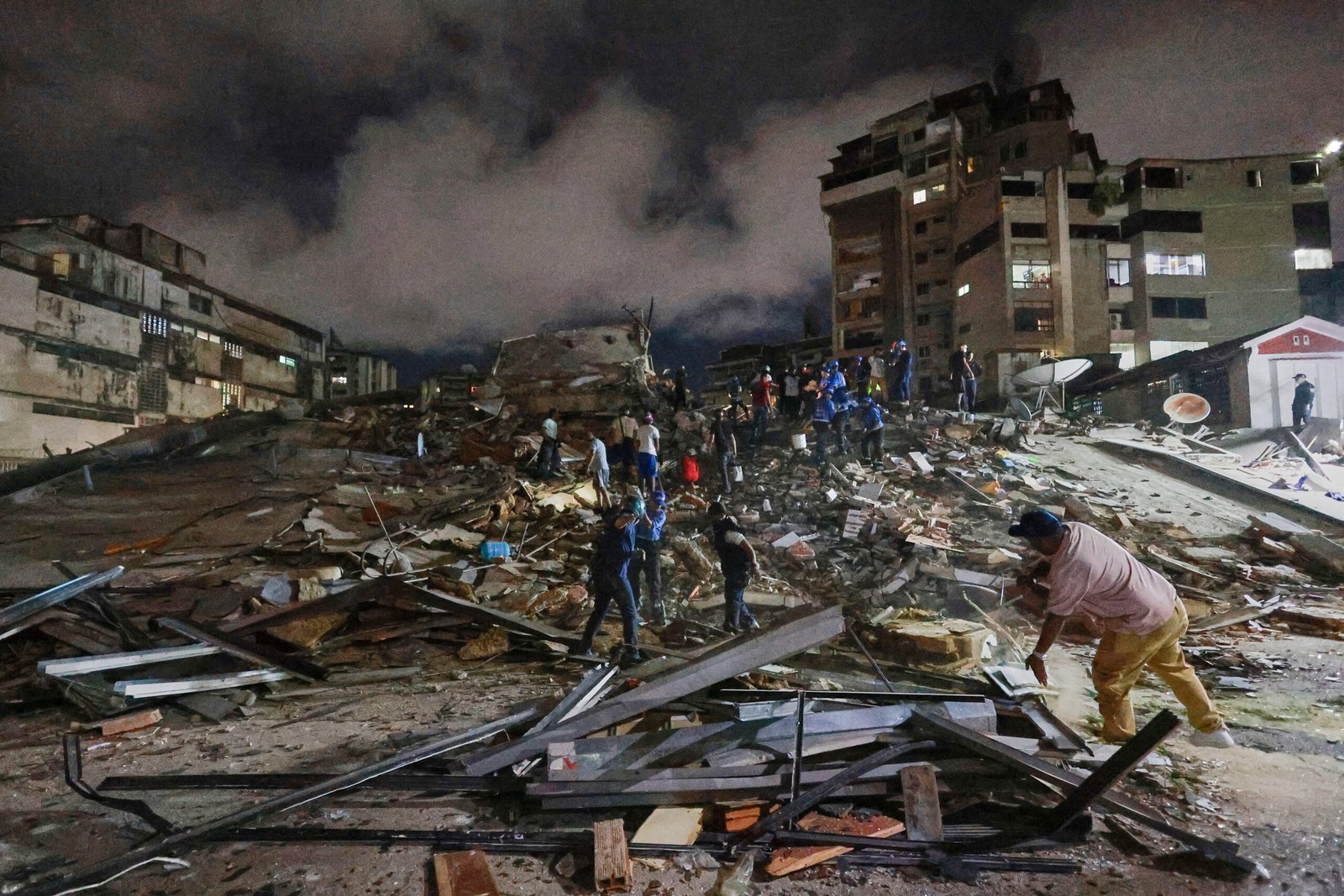
Venezuela was struck by one of the worst natural disasters in its modern history on June 25, when two powerful earthquakes measuring 7.2 and 7.5 hit the country within less than one minute of each other.
The violent shaking caused widespread destruction across the capital city of Caracas, where numerous buildings collapsed, roads cracked apart, and terrified residents rushed into the streets seeking safety.
Authorities have confirmed at least 32 deaths and more than 700 injuries so far. However, early disaster assessment models suggest that the final death toll could climb dramatically and may potentially exceed 100,000 people, making it one of the deadliest earthquakes in Latin American history.
Two Major Earthquakes Within 39 Seconds
According to the United States Geological Survey (USGS), the first earthquake measured magnitude 7.2 and struck at a depth of approximately 13 kilometers, classifying it as a shallow earthquake capable of causing severe damage.
Just 39 seconds later, a second and even stronger magnitude 7.5 earthquake hit at a depth of around 22 kilometers.
Seismologists describe this rare phenomenon as a “doublet earthquake,” where two major earthquakes occur in quick succession. The first quake weakens buildings and infrastructure, while the second often delivers catastrophic destruction to already damaged structures.
Experts warn that doublet earthquakes are typically far more devastating than a single large earthquake.
Caracas Descends Into Chaos
Although the epicenter was located west of Caracas, the shallow depth and high population density turned the capital into one of the hardest-hit areas.
Videos circulating on social media show entire apartment facades collapsing, vehicles buried beneath debris, and streets covered with shattered glass and concrete.
Thousands of residents fled their homes barefoot and gathered in parks, parking lots, and open spaces while desperately searching for missing family members.
Many survivors reported that furniture was thrown across rooms and walls appeared to twist under the intense shaking.
One local resident described the terrifying experience:
“I thought it was just a normal earthquake, but less than a minute later the second one hit. It felt like the entire building was being torn apart.”
Coastal Cities Suffer Severe Damage
The destruction was not limited to Caracas.
The states of La Guaira, Miranda, Aragua, Carabobo, and Falcon also experienced significant damage.
Several seaside hotels and residential complexes collapsed entirely, leaving rescue teams racing against time to locate survivors trapped beneath the rubble.
Damaged roads and disrupted communication networks have made it difficult to determine the full extent of the disaster, raising concerns that the actual death toll could be far higher than currently reported.
More Than 6,600 People Missing
International media reports indicate that over 6,600 people have been reported missing, many of whom are believed to be trapped under collapsed buildings.
Rescue operations have been repeatedly interrupted by powerful aftershocks, while damaged bridges and landslides continue to hinder access to affected areas.
Venezuela’s prolonged economic difficulties have also contributed to the severity of the disaster, as many older buildings lacked modern earthquake-resistant construction standards.
Hospitals in several regions are reportedly overwhelmed, facing shortages of medical supplies, beds, and personnel.
Some medical facilities themselves sustained damage during the earthquake.
Trump Says Early Reports Are “Not Encouraging”
U.S. President Donald Trump addressed the disaster during a press briefing at the White House, describing the preliminary reports as “not encouraging.”
Trump announced that the United States had activated emergency international disaster response mechanisms and was preparing to deploy rescue personnel, medical teams, and humanitarian aid to Venezuela.
He emphasized that the greatest concern remains the large number of individuals believed to be trapped beneath collapsed structures.
“Every hour matters in a disaster like this,” Trump stated.
He also called upon the international community to cooperate in relief efforts to prevent further loss of life.
National State of Emergency Declared
In response to the unprecedented disaster, Venezuelan authorities declared a nationwide state of emergency.
The government announced several emergency measures, including:
- Closure of schools nationwide.
- Suspension of non-essential public activities.
- Mandatory evacuation of damaged buildings.
- Mobilization of medical personnel.
- Activation of mass casualty emergency protocols.
Military units have also been deployed to assist with rescue operations and maintain public order.
Airports Closed and Transportation Paralyzed
The country’s main international gateway, Simon Bolivar International Airport, was forced to shut down after reports of runway and terminal damage.
Caracas’ metro system and railway networks have suspended operations due to safety concerns.
Several highways suffered severe cracks and bridge damage, significantly slowing the movement of emergency vehicles and aid supplies.
Transportation disruptions remain one of the biggest challenges facing rescue efforts.
Residents Sleep Outdoors as Aftershocks Continue
Authorities have recorded more than 20 aftershocks since the initial earthquakes, with several exceeding magnitude 5.
As a result, thousands of residents are refusing to return to their homes and are instead spending nights in public parks and open spaces.
Emergency officials warn that even buildings that appear structurally intact may have suffered hidden damage and could collapse during future aftershocks.
Citizens have been urged not to re-enter damaged structures unless they are officially declared safe.
Could the Death Toll Exceed 100,000?
One of the most alarming developments comes from USGS disaster modeling estimates.
According to preliminary assessments:
- There is a 44% probability that fatalities could exceed 10,000.
- There is approximately a 30% chance that deaths could surpass 100,000.
The estimates are based on factors including population density, building vulnerability, earthquake depth, and the geographic extent of the affected area.
Because many people were indoors when the earthquakes struck, experts fear casualties may continue to rise in the coming days.
Why Does Venezuela Experience Major Earthquakes?
Many people associate devastating South American earthquakes with countries such as Chile, Peru, or Ecuador.
However, Venezuela sits near the boundary between the Caribbean Plate and the South American Plate, making it vulnerable to significant seismic activity.
The country experienced a catastrophic earthquake in 1812 that killed approximately 30,000 people and remains one of the deadliest disasters in Venezuelan history.
Some seismologists believe the 2026 double earthquakes may eventually surpass the destruction caused by that historic event.
International Community Mobilizes Assistance
As the scale of the disaster becomes clearer, countries around the world have begun offering support.
The United States, Brazil, Mexico, China, Spain, Ecuador, and the Dominican Republic have all expressed willingness to provide rescue teams, medical assistance, and humanitarian aid.
The United Nations is also reportedly evaluating the activation of international emergency response mechanisms to accelerate relief and reconstruction efforts.
The Golden 72 Hours
For major earthquakes, the first 72 hours after the disaster are widely regarded as the critical window for rescue operations.
History has shown that miraculous survivals can still occur even after days trapped beneath collapsed buildings.
Today, the eyes of the world are focused on Venezuela.
Rescue teams continue to dig through the rubble despite ongoing aftershocks, hoping to find signs of life beneath the debris.
Yet with each passing hour, the likelihood of finding survivors gradually decreases.
This tragedy, already being described by some media outlets as a “once-in-a-century disaster,” serves as another reminder of the immense power of nature.
When cities collapse, communication fails, and infrastructure disappears, humanity is often left with only one thing to rely on: each other.
And today, Venezuela waits for that hope to arrive.