
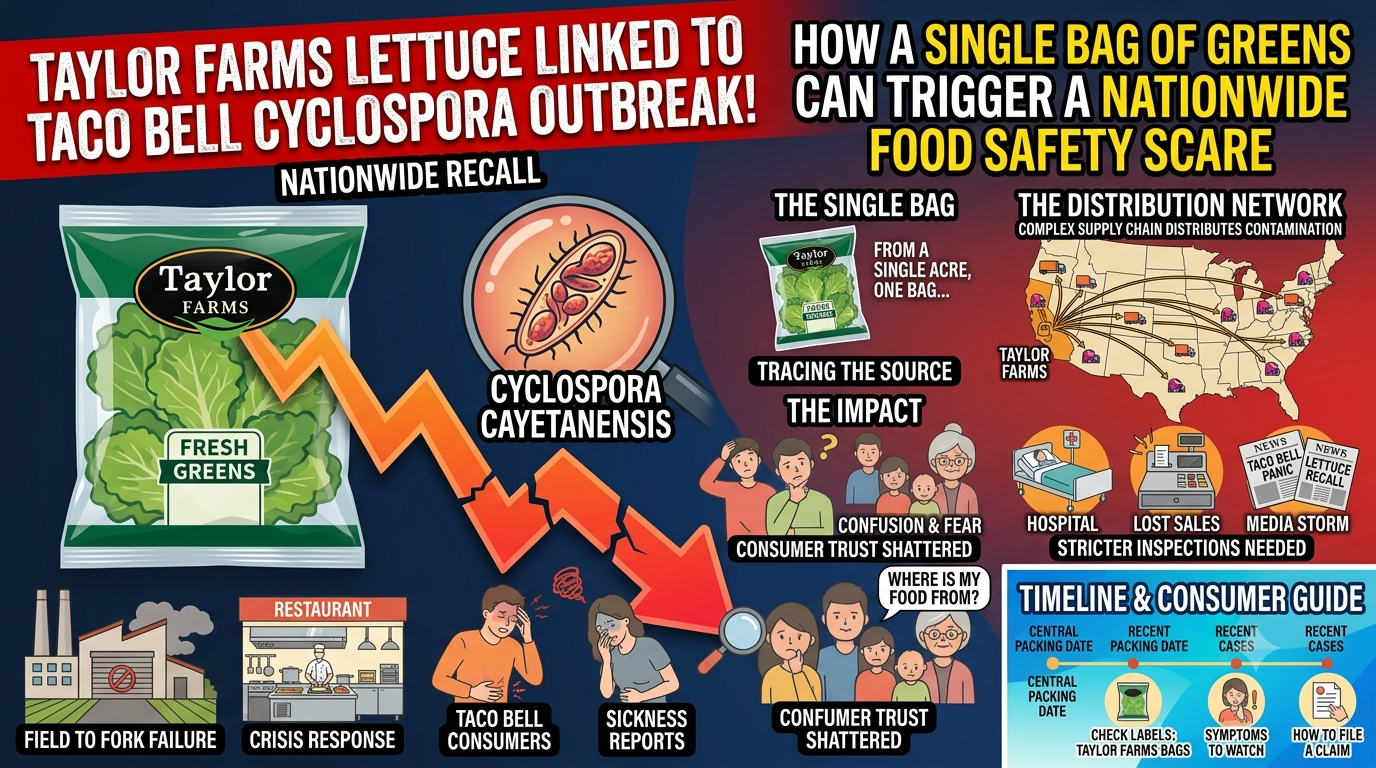
A simple ingredient found in a fast-food meal has become the center of a growing food safety investigation in the United States.
Lettuce supplied by Taylor Farms and used in Taco Bell restaurants has been identified by U.S. health officials as a possible source linked to a recent Cyclospora outbreak, a parasitic infection that causes severe and persistent diarrhea.
The investigation is still ongoing, and officials have not confirmed that Taylor Farms lettuce is the only source of contamination.
But the case has already raised a bigger question:
How can a single vegetable ingredient spread illness across multiple states?
The answer lies in the modern food supply chain.
A single farm, processing facility, or shipment can supply thousands of restaurants — turning one contamination event into a nationwide food safety concern.
What Happened? Taco Bell Lettuce Became the Focus of a Multi-State Investigation
The outbreak investigation began after health officials noticed a pattern:
Many people who became sick had recently eaten at Taco Bell.
Investigators looked at what these customers had in common.
The answer was not a specific restaurant location.
It was a shared ingredient.
Many affected meals contained shredded iceberg lettuce.
As investigators traced the supply chain, Taylor Farms became part of the investigation because of its connection to the lettuce supply.
Reported affected areas include:
- Indiana
- Kentucky
- Michigan
- Ohio
- West Virginia
Taco Bell responded by taking precautionary steps, including removing certain lettuce products and reviewing suppliers.
However, health officials continue to investigate, and the exact contamination source has not yet been officially confirmed.
What Is Cyclospora? The Parasite Behind the Outbreak
Cyclospora is not a typical stomach bug.
It is a microscopic parasite called Cyclospora cayetanensis that infects the human intestine.
Unlike some bacteria that cause food poisoning within hours, Cyclospora often takes days or even weeks before symptoms appear.
The most common symptoms include:
- Persistent watery diarrhea
- Stomach cramps
- Bloating
- Nausea
- Vomiting
- Loss of appetite
- Fatigue
- Weight loss
For some people, symptoms can come and go for weeks if untreated.
That delayed reaction is one reason Cyclospora outbreaks can be difficult to trace.
People often do not immediately remember what food caused the infection.
How Does Cyclospora Spread? The “Feces → Environment → Food → Human” Chain
The transmission process is surprisingly specific.
Cyclospora usually spreads through a fecal-oral route.
The cycle works like this:
Step 1: An infected person releases parasite eggs
An infected person passes immature Cyclospora eggs, called oocysts, through their stool.
Step 2: The parasite develops in the environment
Those immature eggs enter:
- Soil
- Irrigation water
- Washing water
They need about one to two weeks in the environment to become infectious.
Step 3: Food becomes contaminated
The mature parasite can contaminate:
- Lettuce
- Herbs
- Fruits
- Fresh vegetables
Step 4: People eat contaminated food
When someone consumes contaminated, unwashed, or raw produce, infection can occur.
Why Doesn’t Cyclospora Spread Easily From Person to Person?
One unusual thing about Cyclospora is that direct person-to-person transmission is uncommon.
Why?
Because freshly released parasite eggs are not immediately infectious.
They need time outside the body to mature.
That means Cyclospora is usually not a “someone sneezed near you” type of infection.
It is more like:
Contaminated environment → contaminated food → human infection
This is why controlling farms, water sources, and food processing facilities is so important.
Why Is Lettuce Such a Common Problem?
The Taylor Farms and Taco Bell case fits a pattern seen in previous Cyclospora outbreaks.
Leafy greens have several risk factors.
1. Lettuce is usually eaten raw
Unlike meat or vegetables that are cooked, lettuce often goes directly from packaging to the plate.
No high heat.
No final kill step.
2. Leaf surfaces are difficult to clean completely
Lettuce leaves have:
- Folds
- Tiny spaces
- Uneven surfaces
Parasites and microorganisms can attach to these areas.
3. Large-scale processing increases exposure
A modern lettuce supply chain often looks like this:
Farm
↓
Processing facility
↓
Cutting and packaging
↓
Distribution center
↓
Restaurants across multiple states
If contamination happens early, many locations may receive the same product.
Why Washing Lettuce May Not Be Enough
Many people assume:
“Just wash the lettuce carefully.”
Unfortunately, Cyclospora is more complicated.
The parasite produces oocysts with a relatively tough outer structure.
Normal household washing methods may reduce contamination but may not completely remove all parasites.
That is why food safety experts focus heavily on:
- Safe irrigation water
- Clean processing environments
- Worker hygiene
- Proper agricultural practices
The biggest protection happens before food reaches consumers.
Why Do Cyclospora Outbreaks Often Happen in Summer?
Cyclospora outbreaks have a strong seasonal pattern.
Cases often increase during:
May, June, and July
There are several reasons.
Warm and humid weather helps parasite development
Cyclospora oocysts mature more easily under suitable environmental conditions.
Summer means more fresh produce consumption
People eat more:
- Salads
- Fresh vegetables
- Cold dishes
- Fresh herbs
- Fruit
The combination creates a higher-risk environment.
What Foods Have Been Linked to Cyclospora Before?
Over the past two decades, Cyclospora outbreaks in the United States, Canada, and Europe have often been connected to fresh produce.
Commonly involved foods include:
Leafy greens
Examples:
- Iceberg lettuce
- Romaine lettuce
- Mixed salad greens
- Spinach
Fresh herbs
Examples:
- Cilantro
- Basil
- Mint
Herbs are especially challenging because they are often eaten raw.
Fresh berries
Examples:
- Raspberries
- Strawberries
- Blueberries
Some previous international outbreaks have involved imported berries.
Why Are Frozen Fruits and Vegetables Less Common Sources?
Commercial frozen produce has rarely been confirmed as a Cyclospora transmission source.
Possible reasons include:
- Different processing methods
- Additional cleaning steps
- Higher chance of being cooked before eating
The biggest risk usually comes from:
Fresh + Raw + Ready-to-eat foods
Such as:
- Salad
- Fresh garnish
- Raw herbs
- Pre-cut vegetable trays
The Hidden Risk: Modern Food Supply Chains
The biggest lesson from the Taylor Farms investigation is not just about lettuce.
It is about how modern food distribution works.
Today, large restaurant chains need:
- Consistent quality
- Large volumes
- Reliable suppliers
That means food production has become highly centralized.
A contamination event at one point in the chain can affect:
- Multiple cities
- Multiple states
- Thousands of customers
The result?
A problem that starts locally can quickly become national news.
Other Foods That Carry Similar Risks
Lettuce is not the only food category that requires attention.
Foods with higher microbial contamination risk often share the same characteristics:
Raw foods that are not peeled
Examples:
- Strawberries
- Raspberries
- Grapes
- Salad greens
Foods with complex surfaces
Examples:
- Spinach
- Kale
- Sprouts
Foods processed and distributed at large scale
Examples:
- Pre-washed salads
- Ready-to-eat vegetable packages
- Restaurant-prepared fresh ingredients
The Bigger Business Impact: Why Food Safety Can Become a Brand Crisis
For companies like Taylor Farms and restaurant chains like Taco Bell, food safety issues are not only operational problems.
They are reputation problems.
Consumers may forget:
- Which batch was recalled
- Which supplier was involved
- Which location was affected
But they remember the brand name.
Potential consequences include:
- Lawsuits
- Product recalls
- Supplier changes
- Increased testing costs
- Loss of consumer trust
For food companies, safety is not just a compliance issue.
It is a core part of brand value.
Final Thoughts: A Single Leaf of Lettuce Reveals the Challenge of Modern Food Safety
The Taylor Farms and Taco Bell Cyclospora investigation highlights a reality of today’s global food system:
A simple ingredient can travel hundreds or thousands of miles before reaching a customer’s plate.
The typical Cyclospora pathway is:
Contaminated water or environment → fresh produce → large-scale processing → widespread distribution → multiple infections
The investigation is still developing, and officials have not reached a final conclusion.
But one lesson is already clear:
In a world of massive food supply chains, preventing contamination at the source is more important than ever.
Because sometimes, a single leaf of lettuce can reveal the hidden risks behind the entire food system.